
Managing Tennis or Golfer’s Elbow: 6 Key Exercises, Stretches
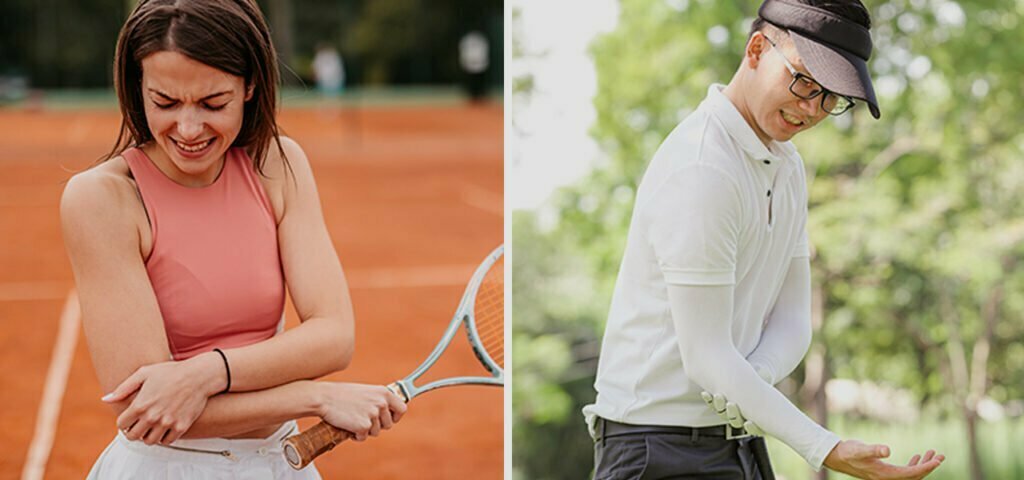
When the weather gets warmer, many Canadians are eager to return to the tennis court or golf course. Due to the repetitive motion associated with these recreational sports, a common injury that can occur is tennis elbow or golfer’s elbow.
Here’s the thing: These injuries aren’t exclusive to their respective sports. Even if you don’t play tennis or golf, you can still experience either over time, which is why it’s important to understand the health care options available to you.
What’s the Difference Between Tennis & Golfer’s Elbow?
Tennis Elbow
Involves the muscles and tendons of your forearm that extend your wrist and fingers. Usually it doesn’t come from an injury, but rather from overuse of the tendons in your forearm.
Symptoms include: weak grip strength and a pain or burning sensation on the outer part of the elbow. Usually, they get worse when you use your forearm in activities that require grip strength (i.e. holding a tennis racquet, turning a wrench, shaking hands, etc.).
Golfer’s Elbow
Involves the muscles that attach from the wrist and go to the “funny bone” area of the elbow near the inner bump. These muscles are responsible for wrist flexion and the twisting inward motion of the wrist.
Symptoms include: pain or tenderness near the funny bone or inner bump of the elbow, as well as reduced strength in your grip.
Exercises & Stretches for Tennis or Golfer’s Elbow
If you have either tennis or golfer’s elbow, there are various exercises and stretches that can help manage your symptoms:

Tennis Elbow
Hold your arm out in front of you, palm facing down, and pull your hand and fingers back towards you using your other hand. Do so gently so as not to cause pain. If doing this hurts, pull more gently for a slight stretch. This should stretch your forearm. Hold for 30 seconds, relax, and repeat three times.

Golfer’s Elbow
Hold your arm out in front of you, palm facing up, and gently pull your hand and fingers back towards your body using your other hand. If doing this hurts, pull more gently for a slight stretch. Hold for 30 seconds, then relax. Repeat three times.
ADDITIONAL EXERCISES
Wrist Extension (beneficial for tennis elbow): Begin with your elbow at a 90-degree angle, palm facing down, resting on a table’s surface. Gently extend your wrist to lift it off the table (this shouldn’t be painful). Repeat 10 times. Holding a water bottle while doing this exercise can help you add resistance and build strength.
Wrist Flexion (beneficial for golfer’s elbow): Begin with your elbow at a 90-degree angle, palm facing up, resting on a table’s surface. Gently extend your wrist to lift it off the table towards the ceiling (this should not be painful). Repeat ten times. You can also add weight resistance to add strength training to the exercise.
Grip Strengthening: Hold a squishy ball or “stress ball” in the hand that’s affected by tennis or golfer’s elbow. Gently squeeze the ball and hold the squeeze for five seconds, then relax. Repeat 10 times.
The “Hammer” Exercise: For this strength-training exercise, you will need a hammer. Hold the handle of the hammer and keep your elbow at 90 degrees — rested flat on a table’s surface. From this starting position, slowly rotate the hammer towards the centre of your body, turning the direction of your palm downwards. Then, slowly reverse the motion, rotating the hammer outwards — your palm begins facing up with the heavy side of the hammer pulling on your arm. Rest briefly. Repeat 10 times.
How a chiropractor can help with Tennis or Golfer’s Elbow
A chiropractor will work with you to diagnose and assess your injury, providing personalized stretches and exercises (may include some of the options mentioned above).
Treatment can involve a combination of care options, including:
- Manual therapy
- Acupuncture
- Laser or shockwave therapy
Additionally, a chiropractor may be able to suggest specific compression or stability braces for your elbow — ensuring that you’re able to once again move with confidence when it’s safe to do so.
Find a Chiropractor in Canada now. Pain changes everything, and chiropractic care changes pain.
DISCLAIMER: No information from this document is intended as a substitute for professional medical advice, diagnosis, or treatment. Consultation with a chiropractor or other primary care provider is recommended for anyone suffering from a health problem. The CCA recognizes that research and data is constantly evolving. Please use this information in conjunction with the best available evidence.